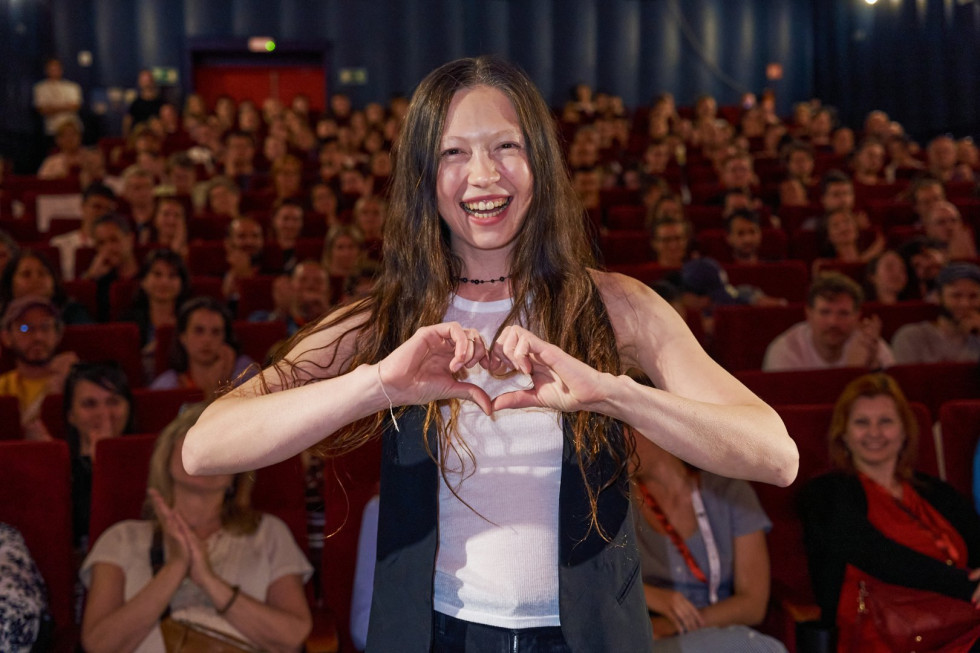
How can one reconstruct one’s own memory within the contours of the Russian regime? The deeply personal hybrid essay Memory (a French-Dutch co-production), screening in the Horizons section, was introduced to Karlovy Vary audiences by its director, Vladlena Sandu, during a post-screening discussion.
“I know it isn’t easy. I deliberately left thirty seconds of silence at the end of the film so that you could begin an inner dialogue,” the director explained, commenting on the unusual choice that concludes this impulsive, immersive, and intimate work, shot on 16mm film. “As a child, you perceive things through vivid details. You don’t perceive time – you exist in the present,” she said, describing the film’s form, assembled from carefully composed and eloquent scenes.
“The screenplay has three layers. The first consists of my diaries, the second stems from hypnotherapy sessions during which I reached deep into my childhood memories. I recorded those sessions. The third layer is a conversation with my friend. She does not appear in the film, however, because she still lives in Russia and participating would have been dangerous for her,” she said, smoothly shifting to the film’s political context.
“While preparing my graduation film, I drew on conversations with my grandmother. She told me what had happened in Chechnya. I had grown up immersed in Russian propaganda, so it was difficult for me to accept reality. I came to realize that I wanted to leave behind my own testimony of how I remember those events,” she said, linking her previous work with her feature debut and her filmmaking approach as a whole.
The making of Memory was, naturally, both difficult and risky. The subject of Chechnya as a “counterterrorist operation” conducted by Russia remains taboo under Putin’s regime. Sandu therefore navigated between the cultural ministries of the two countries, even submitting a fabricated screenplay glorifying her grandfather, a Second World War veteran, in order to obtain the necessary permits. During filming, three representatives sent by the Chechen government were present on set at all times.
“They had no way of verifying what we were actually filming. The experimental form seemed strange to them. Even so, during production we were thrown out of our hotel. In fact, not even my own crew knew everything. I wanted to protect them,” she concluded, closing with a remarkably powerful testimony about making a film under the grip of the Russian regime.