July 06, 2026, 15:18
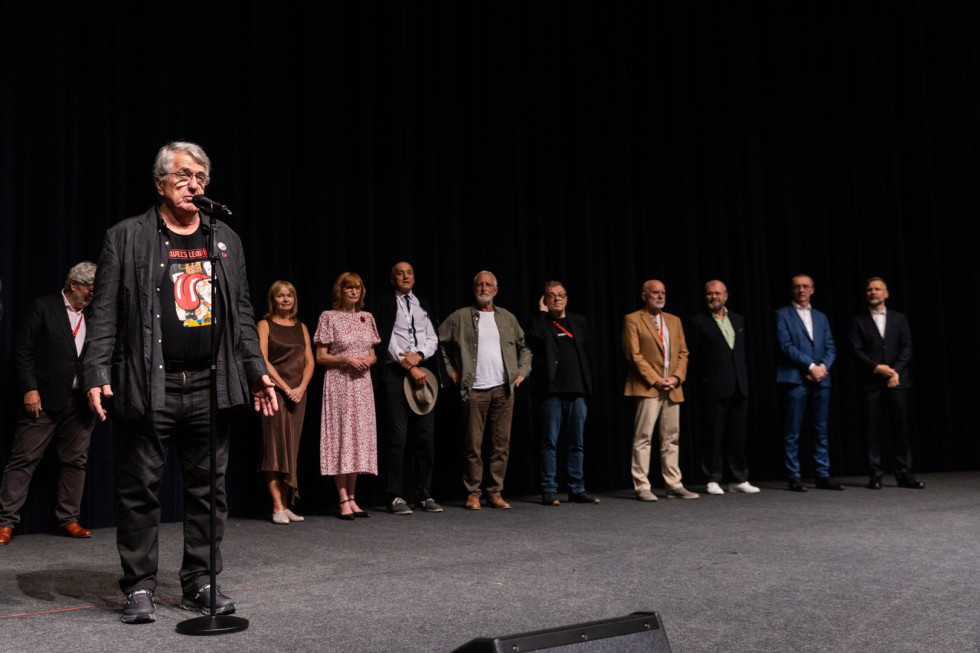
On Sunday, Jaroslav Bouček was inducted into the Audiovisual Producers’ Association Hall of Fame, established by the association he co-founded in 1994. The honour was followed on Monday by a discussion at the KVIFF.TV Park, preceded by the screening of a short tribute film in which Bouček reflected on his remarkable career and the many challenges of the producer’s profession. Among the advice he offered to emerging filmmakers, he emphasised one key principle: never begin a film without secure financing.
In a discussion marked by equal measures of pragmatism and passion for filmmaking, Bouček looked back on the years before the Velvet Revolution. He recalled taking on projects that, because of their labour-intensity, few others were willing to produce. Those productions included beloved children’s television series such as Mr Tau, The Visitors, and Circus Humberto. That was where he learned the craft of filmmaking. These international co-productions with West Germany also introduced him to a very different system. Over the course of his career, he went on to produce works by acclaimed Czech directors including Jiří Menzel and Věra Chytilová.
“They’re wonderful films that, in my view, belong in the canon of Czech cinema,” Bouček said. One of them, Tainted Horseplay, which was filmed in Karlovy Vary and is screening at this year’s festival in a newly restored version, was also produced by Bouček. “I’m a Karlovy Vary man through and through. I’ve been coming here since the late 1970s,” he said, recalling stories from the production with Věra Chytilová and Jiří Bartoška, who played a charismatic playboy in the film. He also revealed that he holds one of the earliest golf club registrations in Karlovy Vary, reflecting another of his lifelong passions.
As the production closest to his heart, Bouček named Sekal Has to Die. “The moment I read the screenplay, I knew it was the best script I’d ever held in my hands.” When asked how he could tell, he replied that it was a matter of feeling. “You just feel it. There’s no way of knowing in advance. If I knew which films were going to win Oscars, I’d be flying over you in a helicopter by now,” he joked.
“You can tell a great film by the fact that it is well-balanced in every respect. That’s what makes it a unique experience. I can tell a film is brilliant if I’m unable to speak for half an hour after it’s finished. When I read a script, I have to feel the emotion in it; otherwise, there’s no point in getting involved,” he explains.
You can also see his film Autumn Spring at the festival on Thursday 9 July from 1 p.m. at the Kaiserbad. Speaking of the black comedy about the irrepressible spirit of old age, he remarked: “As Europeans, we don’t tend to like films about old people. We’ve won about six festivals in the US. Members of the Academy told me it was a shame the film hadn’t been submitted for the Oscars. It would have had a real chance. They even wanted to make a remake.”
The award-winning producer, whose experience in the state-run film industry and tireless work after the Velvet Revolution enabled him to make a seamless transition into independent filmmaking, also spoke about collaborating with Václav Havel on the screen adaptation of Leaving and about his most recent production, Golden Sting. Of both films, he noted that although they were not major commercial successes, the themes they explore have only grown more relevant with time.
First-hand brews throughout the year.
Be among the first to learn about upcoming events and other news. We only send the newsletter when we have something to say.