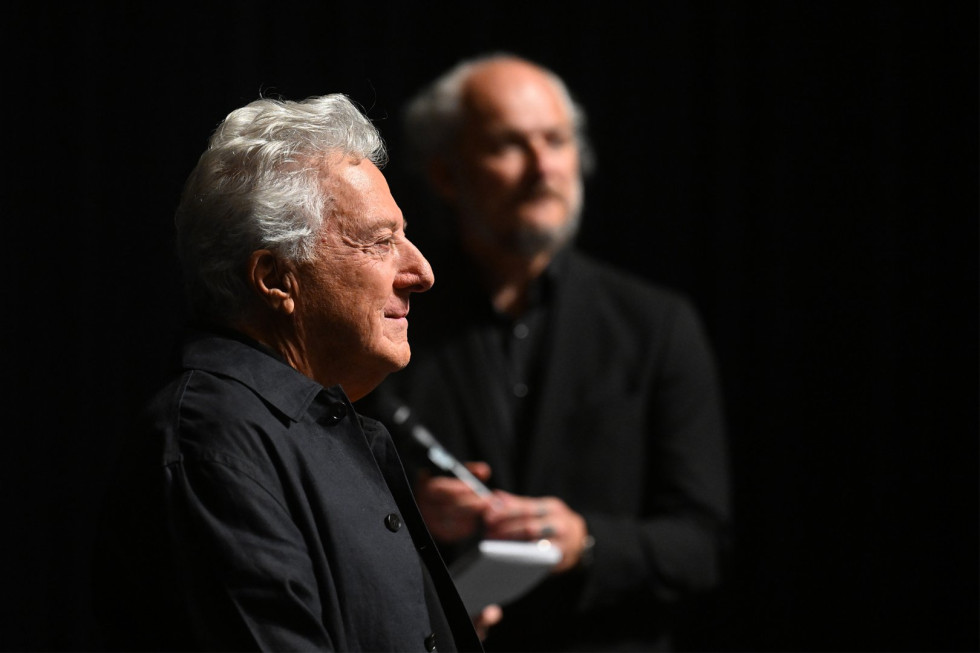
“We’re about to experience one of those truly exceptional moments. An actor you admire introducing a film you love,” said KVIFF Artistic Director Karel Och as he welcomed Dustin Hoffman to the stage. The recipient of the Crystal Globe for Outstanding Artistic Contribution to World Cinema chose to present The Graduate.
The landmark 1967 classic helped usher in the New Hollywood era and launched what has become an almost six-decade-long career. As Hoffman told the Karlovy Vary audience, however, landing the role of the unconventional young Benjamin was largely a matter of chance. “The film’s director, Mike Nichols, was like today’s Spielberg. He spent two years trying to cast the film without success – I actually read that in his biography. At one point, he thought the film would never get made. Then, on the very last day of casting, Katharine Ross and I walked in. If we’d shown up two years earlier, we never would have been cast. The roles would have gone to whoever happened to come in on that final day instead,” Hoffman said, reflecting on the role that chance played in the making of what went on to become the highest-grossing film of the year.
Asked how a film from the 1960s can still resonate with audiences in their twenties today, Hoffman suggested that, in some ways, little has changed. “The novel was published in 1964, before the Vietnam War divided the country, just as America is divided today.” For Hoffman, one of the film’s central themes is the role of parents: “They came of age during the 1930s, the time of the Great Depression. The war gave them jobs. But instead of giving their children themselves, they gave them things. You’ll see that in the film.”
“When we are twenty, we don’t know who we are. We look in the mirror and see the person we’d like to be. But that’s not who we are. We spend years searching for ourselves. And I’m still searching today,” Hoffman concluded.