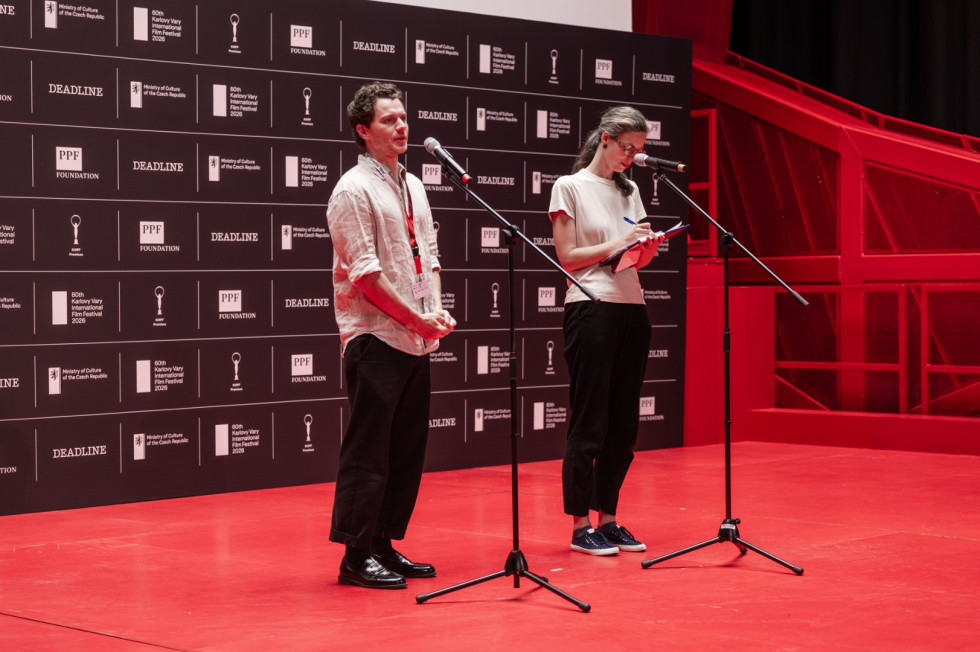
Following its premiere at Sundance, the empathetic road movie Hot Water arrived in Karlovy Vary’s Horizons section, accompanied by director Ramzi Bashour. The film follows the evolving relationship between a mother and her son as they travel to reunite with the boy’s estranged father in the hope of saving his high school education.
Bashour explained that the story is deeply rooted in his own life. “My mother is from Indiana and my father is Syrian I grew up in Beirut, but after the 2006 Lebanon War I moved to the United States to live with my aunt. After finishing my studies, I didn’t want to stay in Indiana. I worked in restaurant kitchens and travelled across the country. My two roommates and I bought a Subaru and set off on a road trip. It was the first time I truly saw how diverse the States are with their mountains and deserts,” he describes.
His travels continued. After his car was stolen in Oakland, he spent some time living in Hawaii. Eventually, however, his adventurous life left him longing for Beirut. He began imagining what his own American road trip might have looked like if it had been undertaken by his former Arabic teacher – someone he admits he used to drive crazy. From that premise, woven together with fragments of personal memories and imagined scenarios, the screenplay gradually took shape.
Filming the road movie became a journey in itself, as it was not only the characters but the entire crew that remained on the move. “It wasn’t hard to convince the crew to come along – it felt like an incredible road trip,” Bashour said. The production travelled with cameras mounted directly onto the car, accompanied by a police escort. Some of the most physically demanding days involved climbing into mountain locations. At the same time, the constantly changing landscape left plenty of room for inspiration and spontaneous ideas.
One of Bashour’s favourite scenes in the film – a quiet, emotionally charged exchange between the protagonists inside a car shimmering in the desert heat – emerged from precisely that spirit of improvisation between the director and his actors. “I liked the idea that the story exists in a kind of vacuum. Even though the characters have a radio in the car, I avoided using diegetic music. I wanted the soundtrack to feel like a mixtape you’d put on during a long road trip,” he explained, describing how he approached the film’s sense of time.