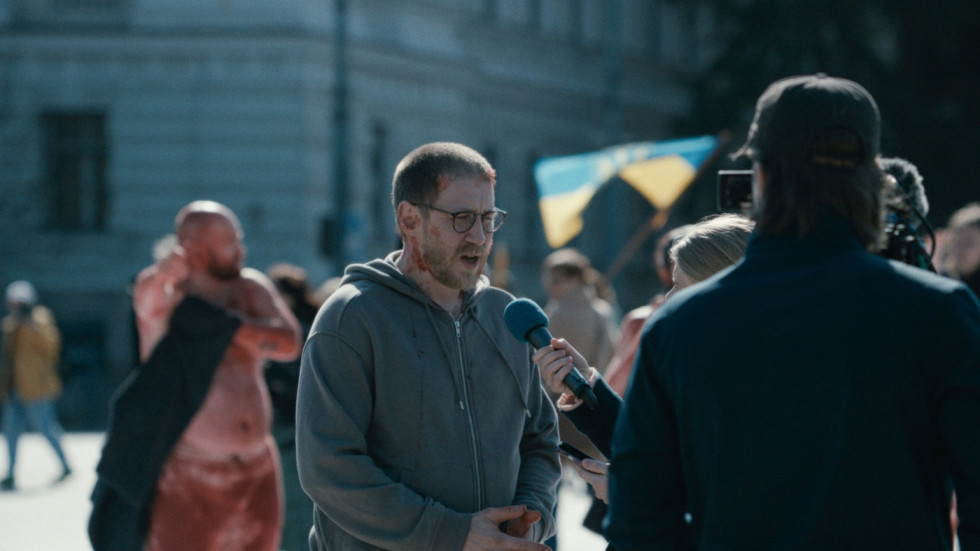
When a wife tells her husband she wants a divorce just hours before Russia invades Ukraine, a family drama suddenly collides with the course of history. Lithuanian director Andrius Blaževičius brought his third feature, How to Divorce During the War, to Sundance this winter, where he won the Directing Award. This summer, he presented the Czech co-production at KVIFF alongside actress Žygimantė Elena Jakštaitė.
“People talk about divorce all the time. Half of all people get divorced, yet there aren’t many films about it. Then the war started, and the two ideas quickly came together,” the director said during the discussion, explaining how the film’s premise came about. According to Blaževičius, the story is rooted in real life. “I also like spending time in my apartment, and I know what a creative crisis feels like. I gave the filmmaker’s character many of my own fears. People really were smashing the windows of cars with Russian licence plates in Vilnius. Other details came from friends. Basically, it’s more or less all true – or rather, more than not,” he revealed.
Speaking about the film, he also gave advice on working with child actors. “You have to cast the right child. At that age, they can’t analyse a role yet. They simply have to be right for it. The only problem was that our young actress didn’t like men, so her relationship with the actor playing her father was complicated. But I didn’t want to manipulate her into anything, because that’s how you can traumatise child actors,” the filmmaker explained.
The director also looked back on the film’s successful Sundance premiere. “The audience there isn’t your typical American audience – it’s made up largely of cinephiles. They were especially interested in the theme of a divided society because it’s something they’re dealing with themselves. They laughed at different moments, but the subject of propaganda, for example, was very sensitive for them.”
The audience in Karlovy Vary, however, did not learn whether the film ends happily or not. “It’s ambiguous. During post-production in Luxembourg, our sound designer thought it was a happy ending, while our re-recording mixer thought it wasn’t. I really liked that,” laughed the director, whose previous feature Runner competed in KVIFF’s Proxima predecessor, East of the West.